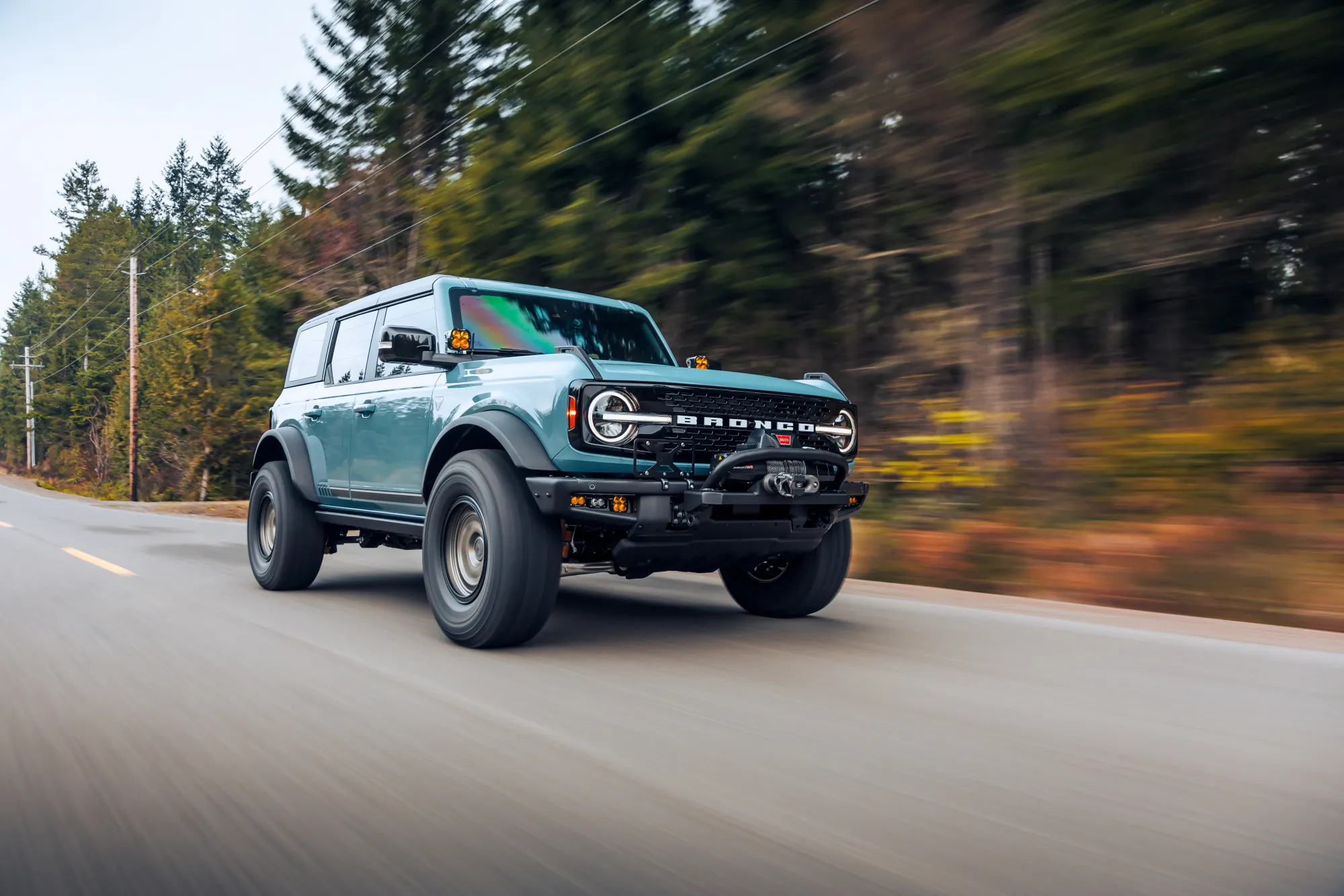
A lift kit changes how a truck looks, how it drives, and how it behaves at night, all at once. The first two are obvious the moment you back out of the driveway. The third is invisible to the person behind the wheel, which is exactly why it gets missed. Raise the body and the suspension, and you raise the headlight housings along with them. The beam that used to land on the pavement a couple hundred feet out now lands somewhere higher, and the people who find out first are the drivers coming at you on US-75 after dark.
If you already run a lift kit on your truck in Sherman, TX, or you are pricing one out for this fall, headlight aim belongs on the list right next to alignment and tire size.
Headlight Aim After a Lift Kit: Why the Light Moves
A modern low beam is not a flood of light. It is a shaped pattern with a defined upper cutoff, engineered so most of the light stays below a line and falls on the road, while very little goes above that line and into oncoming eyes. That cutoff only works if it is pointed where the engineers assumed it would be pointed.
A lift changes two things at once. The housings sit higher off the ground, so the whole pattern starts from a taller position. And most lifts and leveling kits change the truck’s rake, meaning the nose sits at a slightly different angle than it did from the factory. Tilt the truck and you tilt the pattern with it, because the headlamps are bolted to the body. A cutoff that used to fall below an oncoming driver’s eye level can end up right at it.
Larger tires do the same thing in miniature. Going up in overall tire diameter raises ride height at all four corners even without touching the suspension, and it also affects things you can feel, like your speedometer reading. Headlight aim after a lift kit is the change you cannot feel, which is why it goes unaddressed on so many trucks around Grayson County.
Why Lifted Truck Headlights Fool the Driver First
Here is the frustrating part. From the driver’s seat, misaimed lifted truck headlights look great. You are sitting above your own beam, looking down at a bright, generously lit road. If anything it feels like an upgrade, because you can see more of the shoulder and more of the ditch than you used to.
The people who experience the problem are the ones you cannot see: oncoming drivers on the other side of the stripe, and the driver ahead of you catching your beam in his mirrors. Their feedback arrives as flashed high beams, and most truck owners read that as somebody being rude rather than somebody telling them something true.
A typical version goes like this. Somebody in Sherman puts a leveling kit and bigger tires on a half-ton pickup over a weekend, drives it all week in daylight without a single issue, and only starts wondering when the flashing on US-75 becomes a nightly routine. Nothing broke. The truck simply is not aiming where it used to.
The Insurance Institute for Highway Safety puts it plainly: properly aimed low beams light up the road ahead without temporarily blinding oncoming drivers. Aim is what separates useful light from glare. And when NHTSA studied why drivers complain about glare, the contributing factors it identified included beam pattern distribution, higher mounting height, lamp intensity, and mis-aim. A lift kit can hand you three of those at once.
What Texas Actually Requires
Texas does not leave lighting to taste, and several sections of the Transportation Code speak directly to lifted trucks.
- Mounting height. Section 547.321 requires at least two headlamps, one on each side of the front, each mounted at a height from 24 to 54 inches. That is a ceiling as well as a floor, and a tall lift on an already tall truck can approach it.
- Beam reach, under load. Section 547.333 requires the high beam to reveal a person or vehicle at least 450 feet ahead “during all conditions of loading,” and the low beam to do the same at 150 feet. That phrase about loading ties legal aim to how the vehicle sits, and a lift is a permanent change to how the vehicle sits.
- Dimming for oncoming traffic. The same section requires a driver approaching an oncoming vehicle within 500 feet to switch to low beam regardless of road contour or condition of loading. On a lifted truck with uncorrected aim, dimming may not be enough on its own. You can be doing exactly what the law asks and still be putting light where the law is trying to keep it out.
- Fog lamps. Section 547.328 permits fog lamps mounted at a height from 12 to 30 inches, aimed so that at 25 feet no part of the high-intensity portion of the beam from a lamp left of center is higher than four inches below the center of the lamp.
Section 547.004 makes it a misdemeanor to operate a vehicle that is not equipped in compliance with those standards. It also lets a court dismiss the charge if the defect is remedied before the first court appearance, which tells you how the state would rather resolve it: get it fixed.
Nobody in Texas Is Checking This For You Anymore
For decades the annual safety inspection was a backstop. It was not a deep audit, but somebody looked at your lights once a year.
That backstop is gone. Under House Bill 3297, non-commercial vehicles in Texas no longer require a safety inspection before registration as of January 1, 2025. An inspection program replacement fee is collected at registration instead, and emissions testing still applies in the counties that require it. Commercial vehicles are still inspected, which is worth knowing if you run work trucks or a small fleet out of Sherman or Denison.
The old program covered basics including headlights, taillights, horn, mirrors, wipers and tires. None of that stopped mattering. Responsibility for checking now sits entirely with the owner and the shop, which shifts headlight aim from something the system caught to something you have to ask for.
Brighter Bulbs Make Glare Worse, Not Better
There is a common wrong turn here. A driver hears his lights are blinding people, decides they must be too weak or too old, and installs a set of cheap, very bright LED conversion bulbs in the factory housings. The glare gets dramatically worse.
The housing, reflector, lens and bulb are engineered as one system. NHTSA certifies the complete headlamp assembly, not the bulb by itself, and has stated that LED replaceable light sources are not permitted in headlamps designed for replaceable bulbs. Dropping an LED conversion into a halogen housing makes the assembly non-compliant with the federal standard, and enforcement of vehicle modifications is left to state law.
A halogen filament is close to a single point of light in a precise spot, and the reflector is cut to bounce light from that exact spot into a controlled pattern. LED conversion bulbs use chips on a small board that cannot reproduce that geometry, so a meaningful share of the output leaves the housing outside the intended pattern. That stray light is not lighting your road. It is going straight into somebody’s windshield.
Manufacturers have gotten better at this. IIHS testing found only 5% of headlight systems tested for the 2026 model year had excessive glare, down from 21% for the 2017 model year. Those gains come from complete, engineered assemblies, and they do not survive a parts-store bulb swap.
What Headlight Aiming Looks Like on the Shop Floor
Aiming is a measurement, not an opinion. The truck goes on level ground and gets squared up to a target at a set distance. In the common wall method, the headlamps sit exactly 25 feet from the target. The beam centers are marked and compared against horizontal and vertical reference lines, and the aim is rejected if the brightest portion of the beam is more than 4 inches above or below the horizontal center line, or more than 4 inches right or left of the vertical center line. Then the housing’s own adjusters are turned until the pattern lands where it should.
A few details decide whether the result is real:
- Correct tire pressure at all four corners. Underinflation changes ride height, and ride height is the whole subject. If you have ever wondered why tire pressure matters beyond fuel economy and tread wear, this is one more reason.
- The truck loaded the way it is normally driven. A work truck carrying tools and a bed load five days a week sits at a different rake than it does empty on Sunday.
- Suspension settled. A freshly installed lift needs to sit at its true ride height before anything gets measured.
- A level surface. A sloped driveway is why the eyeball-the-garage-door method fails.
Four inches sounds like a generous margin until you follow the beam down the road. That same 4 inches of error at the 25-foot target grows roughly twelvefold by 300 feet out, about the height of an oncoming driver’s face. Small at the truck, enormous on the highway.
Fog Lights and Auxiliary Lamps Move Too
Headlamps are not the only lights bolted to the front of a lifted truck. Fog lamps have their own legal window of 12 to 30 inches, and auxiliary driving lamps have theirs. A truck whose fog lamps were perfectly legal from the factory can have those same lamps sitting above the ceiling after a lift, without anything about the lamps themselves changing.
Fog lamps are also the least forgiving lights to have aimed high. They are meant to throw a wide, low band of light under fog and dust, close to the ground. Raise them and tilt them and they become another glare source. The same goes for a bumper-mounted light bar. If your build added lights, mention every one of them when you bring the truck in.
Aiming Too High Costs You Distance, Too
Light aimed above the pavement is light you are not using. Low beams already cover far less ground than high beams; in one IIHS test, a driver could spot obstacles 202 feet ahead on low beams compared with 533 feet on high beams. Push a low beam’s useful output up into the treeline and you shorten your own sight distance on exactly the roads where it matters most.
That is a real concern in this part of Texoma. US-75 runs at highway speed from Sherman north toward Denison and the Oklahoma line, and the FM and county roads out toward Van Alstyne and Whitesboro have no streetlights at all. On those roads your low beams are the only thing between you and a deer stepping out of a fence line. IIHS has found that vehicles with good-rated headlight visibility had 19% fewer nighttime single-vehicle crashes and 23% fewer nighttime pedestrian crashes than poor-rated ones.
When to Get Your Headlight Aim Checked
Have the aim checked after any of these:
- A lift kit or leveling kit installation
- A change in tire or wheel size, even without suspension work
- Suspension work of any kind, including new springs, shocks or a ride-height change
- A front-end collision, or a bumper or grille replacement
- Adding a winch, brush guard, plow mount or other heavy front accessory
- Switching bulbs or headlight housings
- Any time oncoming drivers start flashing you
If you are booking a lift kit installation in Grayson County, schedule the aim check as part of the same visit. The truck is already on the lot and the suspension is already at its new ride height. It is also the moment to have the alignment set and the tire size sorted out, since all three follow from the same ride-height change. A lift can change how the truck tracks, so if it starts pulling to one side afterward, mention that at the same appointment.
Get Your Lifted Truck Aimed Right at Woods Tire & Auto in Sherman, TX
A lift kit should make your truck better in every direction, including after sunset. At Woods Tire & Auto in Sherman, we install lift kits and check headlight aim as part of doing that work properly, so your lifted truck lights the road instead of the windshield across the stripe. If you want to know what a lift, a set of tires, or a headlight aim check would run for your specific truck, request a current quote and we will give you real numbers for the work in front of you rather than a figure from a blog post that went stale a year ago.
Serving drivers throughout Sherman, Denison, Van Alstyne, Whitesboro and the rest of Grayson County.